
新闻中心
In Europe and America, Glue is commonly used as a synonym for Adhesive. Natural adhesives are commonly referred to as Glue, which is equivalent to “glue” in Chinese. It is a traditional idiom, such as Animal Glue for animal glue and Vegetable Glue for plant glue. After the 20th century, with the use and development of synthetic adhesives, the term adhesive became popular, such as epoxy adhesive for epoxy resin adhesive and hot melt adhesive for hot melt adhesive. There are various different names for adhesive in Europe and America, such as; Bonding Agent, Cement, Contact Cement, Neoprene Cement, etc. Among them, Cement does not refer to cement, but represents hardening, that is, it has the meaning of adhesive. In addition, binders also have the significance of adhesives. For example, the adhesive applied to the back of bound books is called a binder. China also has different names for “adhesive” and “bonding”. Adhesive is also called adhesive, bonding agent, glue, bonding agent, etc; The word “adhesive” used in Taiwan, China should come from Japan. Adhesive bonding is also known as bonding, adhesive bonding, adhesive bonding, etc. The most commonly used terms are adhesive and bonding.
The two most confusing words used in the Chinese adhesive industry should be “sticky” and “adhesive”, mainly due to changes in the country’s two language regulations and people’s habitual use. ‘Yan’ (zh ā n) and ‘Ni á n’ (ni á n) were originally two characters. In 1955, the national ‘First Batch of Variant Character Sorting Table’ was promulgated and implemented, and ‘Yan’ was abolished as a variant character of ‘Yan’. Thus, ‘sticky’ simultaneously holds two positions, representing both the meaning of ‘sticky’ and ‘sticky’. When using ‘sticky’ as an adjective, read ‘ni á n’ instead of the word ‘sticky’, such as clay, viscous, adhesive; When ‘stick’ is used as a verb, it is pronounced as’ zh ā n ‘, such as pasting, bonding, coating, blocking, etc. Before 1988, whether it was books, magazines, or industry professionals, they all used terms such as “ni á n adhesive”, “ni á n bonding agent”, and “zh ā n bonding” without any objections. After decades of use, people have formed a habit. The confusion in the use of “sticky” and “sticky” should have occurred after 1988. The character “sticky” is one of the 15 previously abolished Chinese characters that were confirmed to be restored in the “Explanation” of the “List of Commonly Used Modern Chinese Characters” jointly issued by the National Language and Writing Commission and the National Press and Publication Administration on March 25, 1988. Confirm that ‘sticky’ is the standard character and separate ‘sticky’ from ‘sticky’. That is to say, in the past when “sticky” was used as an adjective and pronounced as “ni á n”, the word “sticky” should be used instead, such as clay, viscous, adhesive, mucous membrane, viscosity, mucus, etc; The word ‘sticky’ is only used as a verb and can only be pronounced as zh ā n. However, due to people’s usage habits, the place where “adhesive” should be used is still “adhesive”. For example, in the “Practical Adhesive Formula Manual” compiled by Zhai Haichao in 1997, according to the “Modern Chinese Common Character List” published by the National Language and Writing Work Committee in 1988, it should be “adhesive”, while the Chemical Industry Press still uses the term “adhesive”; In 2000, another book titled “Practical Adhesive Formulas and Production Technologies” edited by Zhai Haichao and published by Chemical Industry Press had already switched to the term “adhesive”. It was not until 2005 that the Chemical Industry Press unified the use of the term “adhesive” in its adhesive related books. The magazine “Chemistry and Adhesive” has also been renamed “Chemistry and Adhesive” since its first issue in 2005. Currently, an increasing number of publishing houses and media magazines are no longer using the term ‘adhesive’ but instead referring to it as’ adhesive ‘.
Due to the lack of mandatory regulations by the government and the long-standing usage habits of people, it is very difficult to use “adhesives” according to the 1988 National Language and Writing Work Committee regulations. At present, authoritative organizations in the industry such as the China Adhesive and Adhesive Tape Industry Association and the China Adhesive Magazine still use the term “adhesive” in their names. Even the name of the National Adhesive Standardization Committee and a series of adhesive standards organized and compiled in recent years still use the term “adhesive”. Key standards such as GB/T2943-1994 “Adhesive Terminology” and GB/T13553-1996 “Adhesive Classification” still use the term “adhesive”; The term ‘adhesive’ is still used in industry technology exchange conference papers and papers published in industry magazines… If these authoritative institutions and media magazines do not actively implement national writing standards, it will be difficult for the industry to correctly use ‘adhesive’ and ‘sticky’. Since 2005, several publishing houses have made a good start by abandoning the term “adhesive” and changing it to “glue” in order to implement the “List of Commonly Used Modern Chinese Characters” jointly issued by the National Language and Writing Commission and the National Press and Publication Administration in 1988.
Small knowledge sharing:
The difference between stickiness and stickiness is: different pronunciations, meanings, and radicals.
1、 Different pronunciations: Sticky pronounced as ni á n, with a two tone tone tone. Sticky is a polyphonic character that can be pronounced as either zh ā n (with a single tone) or ni á n (with a two tone tone).
2、 Different meanings: The word “sticky” refers to the property that allows one object to adhere to another like glue or paste, often referring to a viscous liquid or the liquid state on the surface of an object, such as thick or sticky. The meaning of the word ‘sticky’ is that sticky substances are connected or attached to each other.
3、 Different radicals: The radical of sticky characters is millet. The radical of the sticky character is next to the rice character.
Adhesive and Adhesive Uses
The character “sticky” is a polyphonic character, and the traditional Chinese character is “sticky”, so it can be used for both “sticky” and “thick” or “sticky”; And the character “sticky” is a monosyllabic character, which is only used as a traditional Chinese character for “sticky” and can only be used for “sticky” and cannot be used for “glue” and so on.
The word “sticky” is used for: viscous, sticky, sticky, sticky cake, sticky, sticky, sticky rice, mucous membrane, clay, sticky, viscous, adhesive, etc., while the word “sticky” is used for: adhesive, sticky, sticky, sticky, adhesive, etc.
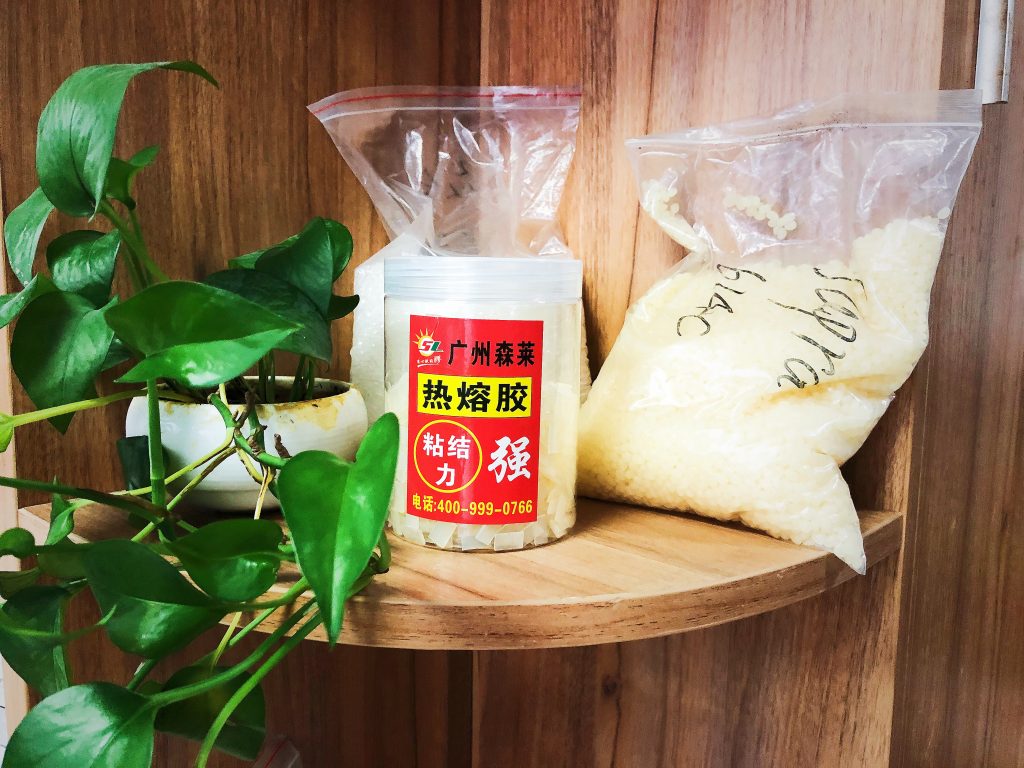
What are the applications of industrial hot melt adhesive? Although most of us may not have come into contact with hot melt adhesive during the manufacturing process, it is one of the most commonly used adhesives in industrial manufacturing. Industrial hot melt adhesive is one of the most widely used adhesives in the market, and […]
Hot melt adhesive is not unfamiliar to cardboard packaging, as it is not only efficient but also cost-effective. Some packaging adhesives, equipment options, and packaging techniques were used when applying hot melt adhesive;. This article helps you understand the technology of hot melt adhesive suitable for your cardboard packaging. Conventional slotted cardboard box (RSC) Use […]
Thread-sewn perfect bindingStill need to use hot melt adhesive particlesThe only difference is the dosage and location compared to wireless adhesive packaging. The sewing thread connects the book stickers one by one, solving the root problem of loose pages in the text; But the smoothness of the book back, the fit between the spine and […]
The occurrence of wire drawing, back cracking, page dropping, or edge glue overflow in book and magazine binding lines may not necessarily be due to “insufficient glue”. The paper coating, glue temperature, glue amount, milling back quality, and finished product cooling time will all jointly affect the results. This article provides a feasible troubleshooting sequence […]