
新闻中心
There are various types of hot melt adhesives with different uses and compositions, generally classified according to their chemical composition and uses.
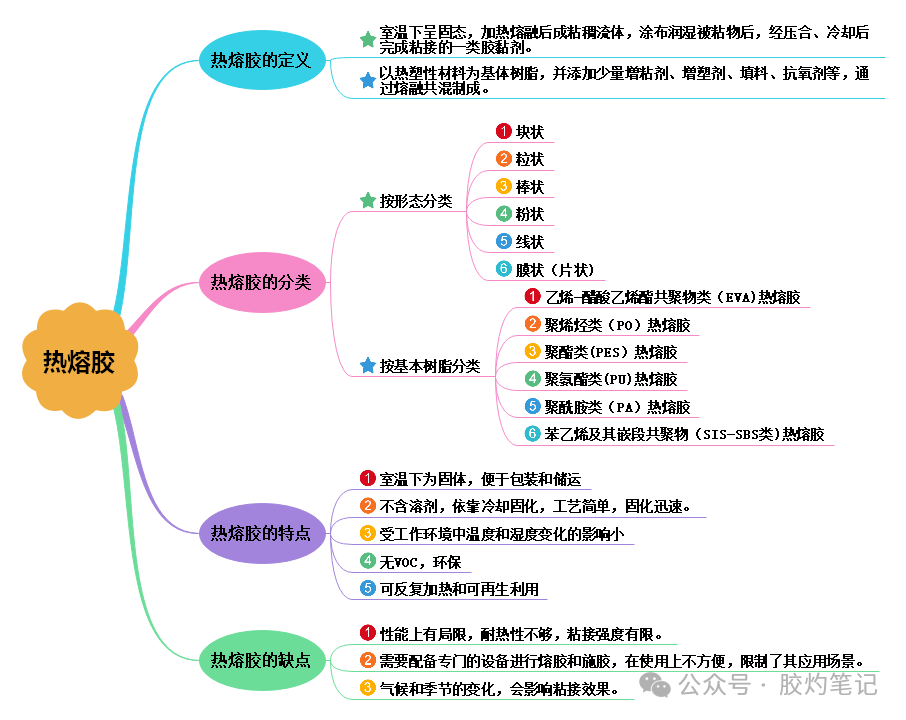
1、 Polyolefin hot melt adhesive
Polyolefin hot melt adhesives include polyethylene hot melt adhesive and polypropylene hot melt adhesive.
Polyethylene (PE)is polymerized from ethylene with a small amount of alpha olefin or other monomers. It can be graft copolymerized with other acids to polarize and improve its adhesive properties..
Features: Odorless, non-toxic, low temperature resistance, good chemical resistance, low water absorption rate. It is a difficult to stick material itself, but when polyethylene is made into hot melt adhesive, it has good adhesion performance to many materials, with advantages such as low price and easy adhesion to porous surfaces.
Main applications: cardboard boxes, cardboard packaging, food packaging container sealing, non-woven fabric production, carpet joint adhesive tape, automotive carpet backing, clothing lining fabric bonding, etc.
Polypropylene (PP) is a thermoplastic resin made by polymerizing propylene. Depending on the spatial arrangement of the methyl side chains of polypropylene, there are isotactic polypropylene, syndiotactic polypropylene, and random polypropylene. The base material of hot melt adhesive is mainly random polypropylene.. Polypropylene itself is one of the difficult to stick materials, but when combined with hot melt adhesives, it has a certain degree of adhesion and unique bonding properties for difficult to stick materials such as polypropylene.
Features: Slightly slow curing speed, low heat resistance, often mixed with low molecular weight polyethylene or crystalline polypropylene to improve curing speed and temperature resistance.
Application: Adhesive bonding of paper, polypropylene, polyethylene, aluminum foil, etc. It is commonly used for paper packaging, carpet backing, paper composite, gap filling, and fixing of TV tube deflection coils.
2、 Ethylene and its copolymer hot melt adhesive
Polyethylene hot melt adhesivehas low mechanical strength. To expand its application range, polar monomers can be introduced to copolymerize with ethylene to improve the adhesive strength to polar surfaces.. There are many monomers that can copolymerize with ethylene, mainly including propylene, vinyl acetate, acrylic acid (ester), maleic anhydride, vinyl chloride, etc. In addition, ethylene ternary or multicomponent copolymers are also used as hot melt adhesives, such as ethylene vinyl acetate vinyl alcohol ternary copolymer resin. Among ethylene copolymer hot melt adhesives, ethylene vinyl acetate copolymer (EVA) hot melt adhesive is the most widely used and widely used type. It is manufactured by high-pressure bulk polymerization or solution polymerization of ethylene and vinyl acetate.
Features: EVA hot melt adhesive has excellent adhesion, flexibility, heat flowability, and cold resistance. In addition, ethylene vinyl acetate copolymer has high cohesion, low melting surface tension, and thermal adhesion to almost all substances. It has excellent chemical resistance, thermal stability, weather resistance, and electrical properties. The disadvantages of this type of hot melt adhesive are low strength, heat resistance, and resistance to fatty oils, so it is mostly used in situations with low strength. Generally, it cannot be used as a structural adhesive, but if copolymerized with heat-resistant hydroxyl compounds such as maleic anhydride, its high-temperature performance can be improved.
Applications: Bookbinding, woodworking, plywood production, packaging, canning, shoe automation operations, paper product processing, construction industry, electrical components, vehicle components, etc. According to the required adhesive properties of the adhesive, such as melt temperature, thermal stability, bending performance, heat resistance, cold resistance, stretchability, and viscosity, different formulations can be selected to produce EVA hot melt adhesive with different characteristics.
3、 Polyester hot melt adhesive
Polyester hot melt adhesive appeared in the 1960s due to its main polymer being a new type of synthetic material with the advantages of high performance and low cost. Polyester (PET) is a general term for polymers containing ester groups (- COO -) in the main chain, divided into two categories: unsaturated polyester and thermoplastic polyester. As a hot melt adhesive, thermoplastic polyester, namely linear saturated polyester, is required as the base material. It is formed by the condensation of diacids and diols or alcohols.
Characteristics: Excellent electrical insulation and good adhesive strength, good impact resistance, water resistance, heat resistance, cold resistance, medium resistance, and elasticity. It has satisfactory adhesion to various materials such as metal, ceramic, glass, cement, fabric, wood, plastic, rubber, etc. Its melt viscosity is high, and manual operation is troublesome. It needs to develop high viscosity glue applicators or add amorphous polyolefins to reduce viscosity and price.
Applications: Clothing, electrical appliances, footwear, construction and other industries.
4、 Polyamide hot melt adhesive
Polymers with repeated acyl amino groups (- CONH -) as the main molecular chain are called polyamides (PA). The hot melt adhesive composed of polyamide as the main material is polyamide hot melt adhesive. The polyamide used to prepare the hot melt adhesive has a relative molecular weight of 1000-9000. Different molecular weights result in different properties. As the molecular weight increases, the strength and adhesion of the adhesive are significantly improved, but the melting point does not change much, and the softening point range is particularly narrow. These properties are beneficial for making hot melt adhesive..
Polyamide hot melt adhesive can be divided into two categories:
One type is high molecular weight polyamide hot melt adhesive, commonly known as nylon type hot melt adhesive. This type of hot melt adhesive is formed by homopolymerization of lactam or amino acid derivatives, condensation of short carbon chain diacids and diamines. Due to their high melting point, poor solubility, and inconvenient use, these nylons are generally treated with formaldehyde to produce hydroxymethylated nylon. When using ternary or higher copolymer nylon, the melting point can be lowered to 150 ℃.
Another type is low molecular weight polyamide hot melt adhesive, which is formed by the condensation of dimers or trimers of plant fatty acids (esters) with organic amines, commonly known as fatty acid polyamide hot melt adhesive. This type of hot melt adhesive has good strength and toughness, and most of its performance is better than EVA type hot melt adhesive.
Characteristics: Polyamide hot melt adhesive has excellent heat resistance, cold resistance, electrical performance, oil resistance, chemical resistance, and medium resistance. It is odorless, colorless, and can cure quickly. Polyamide has good affinity with various metals and non metals, excellent adhesion, and good compatibility with other resins. It can be blended to improve performance.
Application: High molecular weight polyamide hot melt adhesive has good fluidity, high bonding strength, and is resistant to dry cleaning and washing. It has been widely used in industries such as clothing and textiles. Low molecular weight polyamide hot melt adhesive is widely used for bonding materials such as leather, fabrics, plastics, and metals, and is suitable for industries such as footwear, automotive, civil engineering, and furniture.
5、 Polyurethane hot melt adhesive
Polyurethane hot melt adhesiveis a type of hot melt adhesive made from thermoplastic polyurethane (PV) as the base material, including thermoplastic polyurethane hot melt adhesive and reactive polyurethane hot melt adhesive.. Polyurethane is the abbreviation for polyurethane, which refers to a polymer with many repeated amino ester (OOCNH -) groups on the main chain of the molecule. Polyurethane is formed by the addition of polyisocyanates and polymer polyols.
Features: Thermoplastic polyurethane hot melt adhesive has better strength than polyester and polyolefin hot melt adhesives, good elasticity, excellent mechanical properties, simple operation, suitable for production on high-speed bonding automatic lines, and does not pollute the environment.
Reactive polyurethane hot melt adhesive combines the advantages of hot melt adhesive, reactive adhesive, and polyurethane adhesive, and is an ideal adhesive that meets the requirements of pollution-free and high production efficiency in industry.
Application: Thermoplastic polyurethane hot melt adhesive is commonly used to bond materials such as fabrics, metals, and glass. Reactive polyurethane hot melt adhesive is applied in fields such as construction, automotive, electromechanical, packaging, book binding, etc., especially suitable for automatic bonding production lines in automotive, construction, and other industries.
6、 Styrene and its block copolymer hot melt adhesive
The representatives of this type of hot melt adhesive matrix are styrene butadiene styrene block copolymer (SBS) and styrene isoprene styrene block copolymer (SIS), which are characterized by fluidity and plasticity at high temperatures, can be plasticized and formed, and exhibit flexibility and resilience when restored to room temperature.
Characteristics: SBS has good solubility and is compatible with many polymers. Adding resin and tackifiers can reduce its melt viscosity, making it very suitable for preparing hot melt adhesives and hot melt pressure-sensitive adhesives.
SIS not only combines the solubility and thermoplasticity of plastics with the toughness and elasticity of vulcanized rubber like SBS, but also has unique and excellent properties that SBS cannot compare to in certain aspects, such as low modulus, low solution viscosity and melt viscosity, good processing performance, good cohesion and excellent adhesion performance. The configured hot melt adhesive has higher transparency and viscosity, making it the main material used to make hot melt pressure-sensitive adhesives.
Application: SBS and SIS hot melt adhesives and their hydrogenated products are used to make various adhesive tapes and labels, as well as to bond metal and non-metal materials. They are widely used in the production of women’s products and diapers.
7、 Other types of hot melt adhesives
Other types of hot melt adhesives include polyvinyl acetate hot melt adhesive, polyvinyl acetal hot melt adhesive, polyvinyl acetate butenoate copolymer hot melt adhesive, polyacrylic acid (ester) hot melt adhesive, polystyrene butyl acrylate hot melt adhesive, epoxy resin hot melt adhesive, butyl rubber hot melt adhesive, moisture cured polyurea hot melt adhesive, silane grafted amorphous poly (alpha olefin) hot melt adhesive, phenolic hot melt adhesive, gluten hot melt adhesive, lactic acid polymer hot melt adhesive, starch hot melt adhesive, ethylene unsaturated alcohol copolymer hot melt adhesive, cellulose derivative hot melt adhesive, ionomer hot melt adhesive, etc., all of which have their own advantages and disadvantages and have their own uses.
The main content of this article comes from: Guowei Plastics, Elastic Portal, Chemical Flat Head Brother, etc
Statement: The content is from the Internet, and this article is for reference and exchange only. The copyright of the reprinted manuscript belongs to the original author and institution. If there is any infringement, please contact us to delete it.
If, like many manufacturers, hot melt adhesive on the packaging line may encounter problems, resulting in slower packaging speed, increased costs, and potential product damage or loss. Let’s take a look at the common hot melt adhesive problems that manufacturers face today and explore possible solutions. Problem 1: UsingHot melt adhesiveToo little If your packaging […]
hot melt adhesiveWhen the glue pot has burnt particles, uneven glue dispensing, or impurities in the glue line, simply replacing the glue may not solve the problem. This article sorts out the troubleshooting sequence according to “glue pot status, temperature setting, shutdown habits, and glue supply path” to help reduce downtime and material waste in […]
Nowadays, more and more books are using EVA hot melt adhesive particles for wireless binding, and almost all large, medium, and small processing factories in China have put this technology into use. This is because the use of this book binding adhesive has the characteristics of fast binding, short operation cycle, good appearance of finished […]
First, correct the conclusion: Hot melt adhesive particles do not have better viscosity at higher temperatures. Heating for a long time above the recommended temperature of 10 ℃ will cause the colloid to oxidize and degrade, resulting in a decrease in adhesive strength instead of an increase. It can also cause a series of problems […]